
Young Fisherman



Young Fisherman
- Artist
- Follower of Frans Hals
- Artist Nationality
- Dutch
- Title
- Young Fisherman
- Date
- c. 1635
- Medium
- oil on canvas
- Dimensions
- 65.4 x 58.8 cm (25-3/4 x 23-1/8 in)
- K Number
- K255
- Repository
- Allentown Art Museum
- Accession Number
- 1960.36.000
- Notes
Provenance
(Thomas Agnew & Sons, London) in 1921; (Count Alessandro Contini Bonacossi [1878-1955], Florence-Rome) by 1923; [1] sold to Samuel H. Kress [1863-1955] on 23 June 1933 as Frans Hals; gift to the Allentown Art Museum in 1961, no. 1961.36. [1] Published as with Contini by W.R. Valentiner, Frans Hals: Die Meister Gemälde, Berlin and Leipzig, 1923, p. 133. Lent by Contini to Mostra di Capolavori della Pittura Olandese, Borghese Gallery, Rome, 1928, no. 41.
Catalogue Entry
Follower of Frans Hals
Young Fisherman
K255
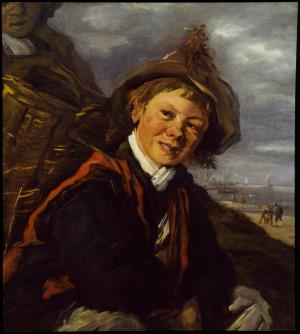
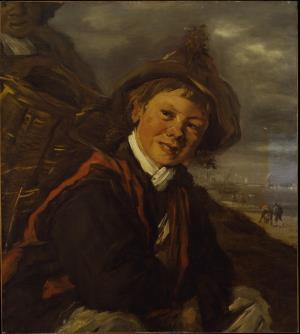
Allentown, Pennsylvania, Allentown Art Museum (61.36B), since 1960. Oil on very finely woven canvas. 25 3/4 x 23 1/8 in. (65.4 x 58.8 cm.). Inscribed with the Hals monogram FH in the lower right corner. Cut down, and over-painted at upper left at unknown date. The painting has an earlier depiction underneath, as indicated by X-ray photography. Abrasion in sky and elsewhere. Relined and restored by Pichetto in 1934. Reinforced at unknown date; the strengthening of the monogram and other over-painting were removed by Modestini in 1951; the figure at the upper left was then revealed. Allentown, 1960, p. 120. The smiling fisherboy wearing a red vest and rustic attire is in a seated or squatting pose in the dunes (probably at Zandvoort), his right hand placed in his coat, his left arm resting on the leg. He has a large wicker fish basket tied to his back, and wears a hat with herbs stuck in the crown. Another fisherman or boy is at the upper left. Fishing boats with four figures on the beach are seen at the lower right. Originally the composition must have been somewhat larger and more vertical, so as to accommodate the upper section of the figure that is now cut down; the artist may perhaps have changed his mind, painting over that figure in order that the design correspond more closely to the conventional format of half-length fisherfolk. The fisherfolk, according to Held, may, like those in the emblematic literature of Jacob Cats, be reminders of the superiority of the natural, rustic life over urban sophistication.(1) Slive observed that figures of fisherfolk were common in Northern art by the late sixteenth century. Such characters were often included in Dutch prints of the four elements to characterize water and were also shown in print series depicting man's occupations, but it was Hals who seems to have invented and popularized depictions of fisherfolk in half-length shown life-size.(2) The Fisherboy was first published by Valentiner, who dated it c. 1635-40 and described it as one of the most compelling of the figure series painted by Hals in the 1630s.(3) He found the seascape reminiscent in its coloring and chiaroscuro of Abraham van Beyeren.(4) Bode considered K255 an excellent work by Hals; Longhi dated it c.1635, commenting upon the prominence of the landscape as unusual in Hals; Norris shared Longhi's views.(5) The landscape section was described by Valentiner as belonging to the 'finest dune pictures of Dutch art and seems more modern in conception than most of the contemporary landscape pictures.'(6) The diagonal composition led Valentiner to suspect that it may have a pendant of a similar subject.(7) A dating of 1635-40 was given for K255 in the Hals exhibition of 1937.(8) The bulk of the 'Fisherfolk' canvases ascribed to Hals were viewed by Van Dantzig as forgeries dating from the second half of the nineteenth century. He included K255 in this category, noting that it was painted over an old canvas.(9) This view was somewhat modified by Trivas, who included Hals's son Harmen (1611-69) as a likely candidate for the painter of the 'Fisherfolk'.(10) If Valentiner's suggestion that K255 was one of a pair is correct, the Fishergirl with a Basket (Brooklyn, Brooklyn Museum) is a likely candidate.(11) Although not by Hals himself, the Allentown Fisherboy is superior to many works of the same genre mistakenly given to Hals and more correctly linked to Judith Leyster. The canvas is painted by a Hals follower, combining the master's figure style with an approach to landscape which differs from Hals's manner. Perhaps his son Harmen Hals painted K255. It is not impossible that the landscape could have been executed by a different hand from the figures; as noted by Valentiner, the landscape suggests the art of Abraham van Beyeren. Provenance: London, Thomas Agnew and Sons, 1921. Rome, A. Contini-Bonacossi, exhibited –Rome, Borghese Gallery, Mostra di Capolavori della Pittura Olandese, 1928, p. 38, Cat. No. 41. Kress acquisition 1933, –exhibited Detroit, Institute of Arts, An Exhibition of 50 Paintings by Frans Hals, 10 Jan.-28 Feb. 1935, Cat. No. 30. Indianapolis, Ind., John Herron Art Museum, Dutch Paintings of the Seventeenth Century, 27 Feb.-11 Apr. 1937, Cat. No. 24. Haarlem, Frans Hals Museum, Frans Hals Tentoonstelling, 1 July-30 Sept. 1937, Cat. No. 63. New York, Schaeffer Galleries, Paintings by Frans Hals, 9-23 Nov. 1937, Cat. No. 14. Grand Rapids, Mich., Art Gallery, Masterpieces of Dutci, Art, 7-30 May 1940, p. 7, Cat. No. 28. Allentown, Penn., Allentown Art Museum, Seventeenth-Celltury Paillters of Haarlem, 2 Apr.-13 June 1965, Cat. No. 38. Washington, D.C., National Gallery of Art, Exhibition of Art Treasures for America from the Samuel H. Kress Collection, 10 Dec. 1961 -4 Feb. 1962, Cat. No. 43.
References
(1) Quoted by Seymour Slive, Frans Hals, Haarlem, Frans Halsmuseum, 1962, Exhibition Catalogue, p. 47, Cat. No. 27. See also his Frans Hals, London, 1970, I, pp. 141-4. Slive dates the fisher children in the middle phase, c. 1630-40. (2) Slive, 1962, loc. cit. (3) Wilhelm R. Valentiner, Frans Hals, Klassiker der Kunst, Stuttgart and Berlin, 1921, pp. 290, 323. At the time, the figure at the upper left comer was still obscured by overpainting. (4) Ibid., Second Edition, 1923, p. 133, and n. 4, p. 315. (5) Transcriptions in Kress Archive. W. Bode's opinion was written in 1924, Roberto Longhi's in 1933, that of Christopher Norris on 28 May 1934. In the same year Oswald Sirén, Wilhelm R. Valentiner, William Suida and F. F. Mason Perkins all certified Hals's authorship of K255. Raimond van Marle and G. Fiocco expressed the same views at an unknown date. (6) Valentiner, Fifty Paintings by Frans Hals, Detroit Institute of Arts, 1935, Cat. No. 30. (7) Valentiner, Frans Hals Paintings in America, Westport, Connecticut, 1936, Cat. No. 53. (8) Frans Hals, Exhibition Catalogue cited Note 1 above, Cat. No. 63. The same dating is given in the Schaeffer catalogue of 1937 (Cat. No. 14). (9) M. M. van Dantzig, Frans Hals, Echt of Onecht, Amsterdam, 1937, pp. 97 ff. and p. 103, Cat. No. 98. (10) N. S. Trivas, The Paintings of Frans Hals, London, 1941, pp. 6, 14. (11) Reproduced by Valentiner, 1921, op. cit. Note 3 above, pl. 108.