
The Virgin Adoring the Child
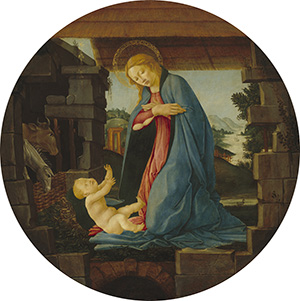


The Virgin Adoring the Child
- Artist
- Sandro Botticelli
- Artist Dates
- 1446-1510
- Artist Nationality
- Italian
- Title
- The Virgin Adoring the Child
- Date
- 1480/1490
- Medium
- tempera on poplar panel
- Dimensions
- diameter: 58.9 cm (23 3/16 in)
- K Number
- K1432
- Repository
- National Gallery of Art
- Accession Number
- 1952.2.4
- Notes
Provenance
Charles Paravey [d. by 1878], Paris; (his sale, Hôtel Drouot, Paris, 13 April 1878, no. 97, as by Filippo Lippi, probably bought in); probably by inheritance to Paravey's daughter, Mme Raynaud, Paris. (sale, Hôtel Drouot, Paris, 16 December 1929, no. 44, as by Filippo Lippi); (Wildenstein & Co., Inc., New York); sold October 1947 to the Samuel H. Kress Foundation, New York; [1] gift 1952 to NGA. [1] The invoice from Wildenstein & Co. to the Kress Foundation (copy in NGA curatorial files) is dated 30 October 1947.
Catalogue Entry
Sandro Botticelli
The Virgin Adoring the Child
K1432
Washington, D.C., National Gallery of Art (1087), since 1951.(1) Wood. Diameter, 23 3/8 in. (59.6 cm.). Good condition, but needs cleaning. In the thirty-five years since K1432 first came to the attention of modem critics, its attribution to Botticelli has been accepted.(2) Proposed datings are about 1480 and about 1490, depending partly on whether the painting to which K1432 is most closely related stylistically, Botticelli's Madonna of the Book in the Poldi Pezzoli, Milan, is dated early or late in the decade. Two instances of Botticelli's subtle symbolism have been cited in K1432: the arch at the bottom of the picture opens into a cave, or abyss, symbolizing death or sin, over which Christ triumphs;(3) the duck, realistically depicted on the water at the right, probably symbolizes reverence, adoration.(4) Both K1432 and K2155 (Fig. 332) are related to Botticelli's drawing of the Nativity in the Uffizi, Florence (no. 209E).(5) Provenance: M. Paravey, Conseiller d'État, Paris (sold, Hôtel Drouot, Paris, Apr. 13, 1878, no. 97, as Filippo Lippi). Mme. Raynaud (daughter of the former), Paris (anonymous sale, Hôtel Drouot, Paris, Dec. 16, 1929, no. 44, as Filippo Lippi; bought by the following). Wildenstein's, New York –exhibited: 'Italian Paintings of the XIV to XVI Century,' Detroit Institute of Arts, Mar. 8-30, 1933, no. 24, as Botticelli; 'A Century of Progress, ' Art Institute of Chicago, June 1-Nov. 1, 1933, no. 109, as Botticelli; 'Five Centuries of European Painting,' Los Angeles County Museum, Nov. 25-Dec. 31, 1933, no. 3, as Botticelli; 'Italian Paintings of the Renaissance,' Century Association, New York, Mar. 2-24, 1935, no. 2, as Botticelli; 'Masterpieces of Art,' New York World's Fair, May-Oct., 1939, no. 21, as Botticelli; 'Masterpieces of Art from European and American Collections,' Detroit Institute of Arts, 1941, no. 4, as Botticelli; 'Italian Paintings,' Wildenstein's, New York, 1947, no. 16 of catalogue, as Botticelli. Kress acquisition, 1947.
References
(1) Paintings and Scupture from the Kress Collection, 1951, p. 52 (catalogue by W. E. Suida), as Botticelli. (2) K1432 has been attributed to Botticelli by A. L. Mayer (in Pantheon, vo1. VI, 1930, pp. 393 f., dating it c. 1490), R. van Marle (Italian Schools of Painting, vol. XII, 1931, p. 171, also dating it c. 1490), W. R. Valentiner (in Pantheon, vol. XII, 1933, p. 238), L. Venturi (Italian Paintings in America, vol. II, 1933, no. 246, dating it c. 1481), J. Mesnil (Botticelli, 1938, p. 225), R. Salvini (Tutta la pittura del Botticelli, 1958, p. 50, dating it c. 1491), and B. Berenson (Italian Pictures ... Florentine School, vol. I, 1963, p. 38). (3) C. de Tolnay, in Revue des Arts, vo1. VI, 1956, p. 163. (4) H. Friedmann, in Studies in the History of Art Dedicated to William E. Suida, 1959, pp. 120 ff. (5) Reproduced by Berenson, Drawings of the Florentine Painters, vol. III, 1938, fig. 193.